

Chưa phân loại
How To Read Non-Fired Concrete Block Sizes: A Buyer’s Guide for Contractors and Importers
When a contractor or importer compares quotations for non-fired concrete blocks, the price per piece is the number that gets the most attention. It is also the least useful number on its own. A block that costs more per unit can cost less per square meter of finished wall, and a block that looks like a match on paper can turn out to be the wrong thickness once plaster is added. The size specification is where most of these surprises begin.
This guide explains how block dimensions are written, how they translate into wall thickness and quantities, and what to verify before you place an order. It draws on the sizing conventions used in Vietnam, where non-fired concrete blocks are produced under the national standard TCVN 6477 and where the same dimension families are now widely specified on regional and export projects.
What “Non-Fired” Means and Why Size Matters More Than With Clay Brick
Non-fired concrete blocks are made from cement, sand, crushed stone and water. The mix is pressed in steel molds and cured rather than burned in a kiln. Because the unit is a molded concrete product, its size is fixed by the mold, which is why dimensions are much more consistent than those of many fired products. It also means that size drives almost everything downstream: weight per unit, number of units per square meter, mortar consumption, laying speed and the thickness of the finished wall.
If you want a broader overview of the common families before going into detail, this summary of common non-fired brick sizes shows how the traditional large block, the tunnel-brick-size units and the hollow block group relate to one another.
How Block Dimensions Are Written
Dimensions are normally given as length × width × height in millimeters. The order is consistent, but the meaning of each number changes with how the block is laid.
Take the most widely used hollow block, 390 × 190 × 190 mm. Laid flat in the usual way, the 190 mm width becomes the wall thickness, the 390 mm length runs along the wall and the 190 mm height sets the course height. Add a mortar joint of about 10 mm and each block occupies a 400 × 200 mm module. That modular logic is deliberate: it fits the 100 mm building module, so doors, windows, lintels and floor heights line up without constant cutting.
The practical consequence is that the figure printed on a price list is the unit size, not the wall thickness. The finished wall also includes the plaster on both faces, and it changes again if the unit is laid on its side. Specifications that say only “200 mm wall” without stating whether plaster is included are one of the most common causes of disputes between design and procurement.
The Main Size Families You Will See Quoted
Large hollow and solid blocks (390 mm series)
This is the structural workhorse. Typical sizes are 390 × 190 × 190 mm, 390 × 190 × 140 mm and 390 × 190 × 100 mm, plus a solid version at 390 × 190 × 90 mm. The tall units suit load-bearing and exterior walls in low-rise buildings. The thinner ones suit partitions and non-load-bearing walls. A full table of dimensions and recommended uses is available in this reference on standard non-fired block sizes.
Planning figures for the 390 × 190 × 190 mm unit are roughly 12 to 13 pieces per square meter of wall including mortar joints. A hundred square meters of wall therefore needs on the order of 1,250 pieces before wastage, compared with several thousand pieces for small-format units. Fewer pieces means fewer joints, less mortar and faster laying, but each piece is heavier, so handling and lifting equipment must be planned.
Mid-size hollow bricks (multi-cell units)
Between the large blocks and the small bricks sits a group of multi-cell hollow units used mainly for partitions and infill. The six-cell format is the best-known example, and it is commonly sold in two sizes: a larger unit of 190 × 135 × 95 mm and a smaller one of 175 × 115 × 75 mm. These weigh roughly 2.8 to 3.2 kg and 1.8 to 2.2 kg respectively. Detailed dimensions, laying orientations and quantity guidance are covered in this breakdown of six-hole brick sizes.
One point of confusion deserves emphasis. A “six-hole brick” in this mid-size format is a different product from a block with six cells at 390 × 190 mm. Both have six openings, but their size, weight and purpose are different. Always ask for the full three-dimension specification rather than relying on the cell count alone.
Small-format solid units
Solid units in the 190 × 90 × 55 mm class mirror the size of traditional fired brick. They are used for detailing, corners, landscaping and decorative work, where small pieces are easier to cut and place. They are rarely economical for large wall areas because the number of joints is high.
Turning Unit Size Into Wall Thickness
The same unit can produce different walls depending on orientation. As an example, the larger six-cell brick (190 × 135 × 95 mm) laid with the 135 mm face as thickness gives a body of 135 mm. With plaster of about 10 to 15 mm on each side, the finished wall is roughly 155 to 165 mm. Laid on its 95 mm side, the same brick gives a much thinner wall of roughly 115 to 125 mm finished.
For a buyer, this means the correct question is not “which block is 150 mm?” but “which unit, laid in which orientation, gives the finished thickness the drawings require?” If the drawings are unclear, resolve it with the designer before ordering, not after delivery.
Estimating Quantities Without Over- or Under-Ordering
A reliable estimate has four steps.
- Calculate net wall area from the drawings, subtracting door and window openings.
- Apply the pieces-per-square-meter figure for the chosen unit, including mortar joints.
- Add a wastage allowance. A range of 5 to 8 percent is a sensible planning figure for cutting, breakage and handling, and renovation work with many irregular dimensions can need more.
- Round up to a transport-friendly quantity and confirm the supplier can deliver the whole order from one production batch.
The theoretical count based only on the face area of the unit overstates what you actually need, because mortar joints occupy space in every course. Always use quantities that already account for the joint.
Dimensional Tolerance and Why You Should Measure Samples
Published sizes are nominal. Real units vary slightly, and the national standard sets permitted deviations. Within tolerance, a skilled mason absorbs the variation in the mortar joint. Outside tolerance, you get uneven joints, thicker plaster, wasted mortar and walls that are hard to finish.
Before committing to a large order, request sample units from the batch you will actually receive, measure length, width and height at several points with a caliper, and compare the results with the tolerances in the standard that applies to your project. Because the permitted deviation differs between product categories and between editions of documents, confirm the exact figure in the current standard rather than relying on a number quoted in a brochure.
Documentation to Ask For
Size is only one part of a compliant product. For projects that require documented quality, ask the supplier for:
- Test reports for compressive strength, water absorption and water permeability from a recognized laboratory.
- Evidence of conformity with the applicable Vietnamese technical regulation, such as certification under QCVN 16:2023/BXD for construction materials.
- A quality management certificate, for example ISO 9001:2015, covering the production site that will actually supply you.
- Confirmation of the strength grade of each size you intend to buy, since strength can differ between hollow and solid versions of the same footprint.
A supplier that can supply these documents quickly usually also controls its molds, mixing and curing well, which is what keeps dimensions consistent from batch to batch.
Choosing Between Block Families: A Quick Decision Guide
| Wall type | Typical choice | Why |
|---|---|---|
| Exterior and load-bearing walls, low-rise | Large hollow block, 390 × 190 × 190 mm | Thickness, insulation and speed |
| Interior partitions | Thin block (390 × 190 × 100 mm) or small six-cell brick | Lighter, thinner, saves floor area |
| Foundation walls, retaining walls | Solid block, 390 × 190 × 90 mm | Higher density and strength |
| Corners, details, landscaping | Small solid brick, 190 × 90 × 55 mm | Easy to cut and place |
| Renovation or added floors | Lightest suitable unit | Limits extra load on existing structure |
Mixing families within one project is normal and often economical. The rule is to avoid mixing different unit sizes inside one continuous wall panel, where uneven joints will show through the plaster.
Common Procurement Mistakes
Comparing price per piece instead of price per square meter of wall. Convert every quotation to a finished-wall basis, including mortar, labor and wastage.
Confusing unit size with finished thickness. Confirm whether the drawing dimension includes plaster.
Ignoring weight. Large blocks are heavy, which affects site handling, crew productivity and loads on existing floors.
Ordering from several sources for one wall. Small differences between producers show up as visible differences in plane and joint width.
Skipping sample measurement. Ten minutes with a caliper is the cheapest quality check available.
Frequently Asked Questions
What is the most common non-fired concrete block size? For walls, 390 × 190 × 190 mm is the most widely used format in Vietnam, with 390 × 190 × 140 mm and 390 × 190 × 100 mm as common variants for thinner walls.
How many blocks do I need per square meter? For the 390 × 190 × 190 mm unit, plan for about 12 to 13 pieces per square meter including joints, then add a wastage allowance of roughly 5 to 8 percent.
Is block size the same as wall thickness? No. Wall thickness depends on the orientation of the unit and the plaster applied to both faces, so the finished wall is thicker than the unit’s body.
Can non-fired blocks be made in custom sizes? Often yes, but custom molds generally make sense only for large orders, and the dimensions should still follow the building module and the applicable standard.
What should I check before accepting a delivery? Measure sample units against the specification, inspect for cracks and chipped edges, and confirm that test reports and conformity documents match the delivered batch.
Conclusion
Reading a block specification correctly is a matter of translating a three-number size into three practical answers: how thick the finished wall will be, how many pieces a given wall needs, and whether the supplier can hold those dimensions consistently. Buyers who convert every offer to a finished-wall basis, measure samples and ask for documentation tend to avoid the expensive surprises that come from treating the block as a commodity.
For specifications and product information on concrete block supply, visit the Concrete Block section of Tran Doan, LLC.

TDG
Bài viết liên quan
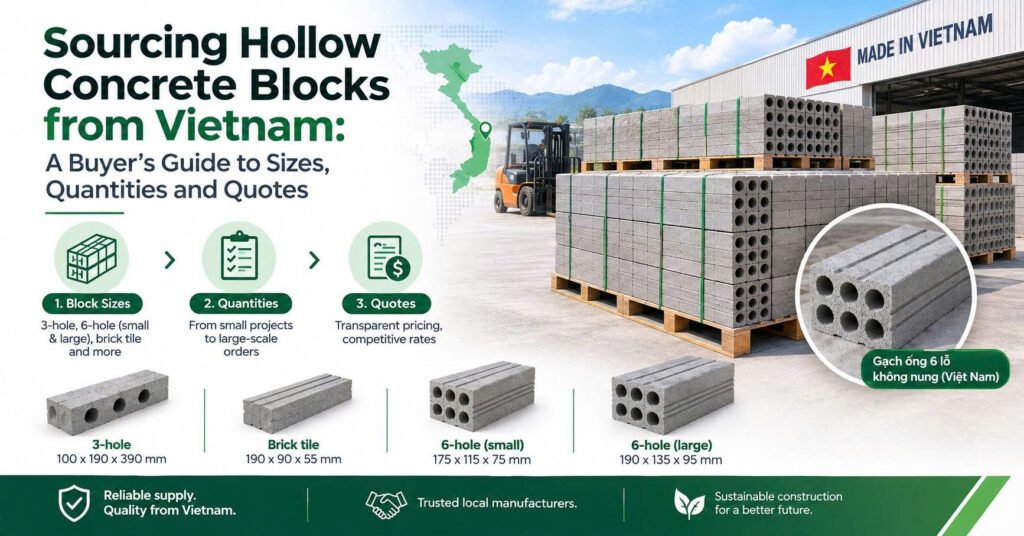
Sourcing Hollow Concrete Blocks from Vietnam: A Buyer’s Guide to Sizes, Quantities and Quotes
Sourcing Hollow Concrete Blocks from Vietnam: A Buyer’s Guide to Sizes, Quantities and Quotes Planning to import non-fired hollow concrete blocks from Vietnam? Learn the common 6-hole block sizes, how to estimate quantities with waste, [...]
Xem thêm
How to Estimate the Total Cost of Non-Fired Bricks for a Construction Project
How to Estimate the Total Cost of Non-Fired Bricks for a Construction Project A construction buyer looking for non-fired bricks may start with a simple question: “What is the price per brick?” However, the unit [...]
Xem thêm
Choosing Terrazzo Tiles for Construction Projects: What to Check Before You Commit
When it comes to paving a pavement, a courtyard, or a walkway, most buyers start with the same question: how much does it cost per square meter? That question is reasonable, but it’s often asked [...]
Xem thêmBlock "slogan-chi-tiet-tin-tuc-vi" not found