

Chưa phân loại
Sourcing Hollow Concrete Blocks from Vietnam: A Buyer’s Guide to Sizes, Quantities and Quotes
Sourcing Hollow Concrete Blocks from Vietnam: A Buyer’s Guide to Sizes, Quantities and Quotes
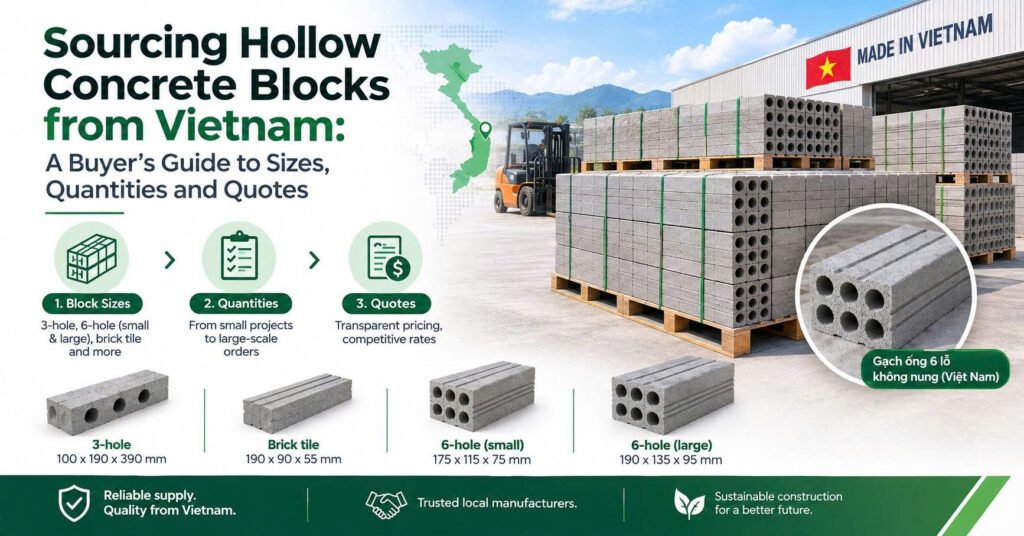
Planning to import non-fired hollow concrete blocks from Vietnam? Learn the common 6-hole block sizes, how to estimate quantities with waste, and what to ask before comparing supplier quotes.
Non-fired concrete blocks are widely used in Vietnam for walls in residential, commercial and industrial buildings, and international buyers are increasingly looking at Vietnamese suppliers for projects abroad. Whether you are an importer, a distributor or a contractor, three questions come up in nearly every inquiry: What size are the blocks? How many do I need? How do I compare quotes fairly? This guide takes them in that order.
1. Know the standard sizes before you request a quote
The most common hollow block in the Vietnamese market is the 6-hole block, sold in two typical sizes:
| Type | Size (L × W × H) | Approx. imperial | Approx. weight |
|---|---|---|---|
| Large 6-hole block | 190 × 135 × 95 mm | 7.5 × 5.3 × 3.7 in | 2.8–3.2 kg (6.2–7.1 lb) |
| Small 6-hole block | 175 × 115 × 75 mm | 6.9 × 4.5 × 3.0 in | 1.8–2.2 kg (4.0–4.9 lb) |
These are noticeably smaller than the standard 8 × 8 × 16 in concrete masonry unit (CMU) common in North America, so quantities and wall details cannot be copied directly from a US specification. In Vietnam these blocks are typically used for infill and partition walls in reinforced-concrete-frame buildings. If you plan to use them in any load-bearing application, confirm suitability with your engineer and local code.
Dimensional tolerance matters too. Vietnam’s national standard for concrete bricks, TCVN 6477, allows only small deviations in length, width and height, and those small differences add up over many courses of masonry. Ask suppliers for the standard they follow, a test report, and a physical sample before approving a full order.
Wall thickness depends on which way the block is laid. For example, the large block laid flat gives a 135 mm (about 5.3 in) wall body, while the small block laid flat gives 115 mm (about 4.5 in), before plaster. A detailed breakdown by orientation, plus guidance on choosing a size for exterior versus interior walls, is available in this guide to 6-hole brick sizes (Vietnamese-language page).
2. Estimate quantities with a simple formula
To estimate blocks per square meter of wall, use:
Blocks per m² = 1,000,000 ÷ [(L + vertical joint) × (H + horizontal joint)]
With a 10 mm mortar joint, the theoretical result is about 48 large blocks per m² or 64 small blocks per m². After adding roughly 7% for breakage, cutting and openings, plan for about 52 large blocks/m² (roughly 4.8 per sq ft) or 69 small blocks/m² (roughly 6.4 per sq ft).
A worked example for a 1,000 m² (about 10,764 sq ft) wall area, after deducting door and window openings:
| Block type | Blocks per m² (incl. waste) | Total blocks |
|---|---|---|
| Large | 52 | about 52,000 |
| Small | 69 | about 69,000 |
These are illustrative figures only. Actual consumption depends on joint thickness, bricklayer skill, handling and storage. Mortar demand also changes with joint thickness, so budget cement and sand separately. A full breakdown of mortar quantities and common estimating mistakes can be found in this guide to 6-hole brick consumption rates (Vietnamese-language page).
3. Compare quotes on the same basis
Two quotes that look different may simply describe different products or different terms. Before comparing, make sure each supplier states:
- Exact block size and standard: large or small, and which standard and test report apply.
- Trade terms: FOB, CIF or another Incoterm, and which port is used.
- Packing: palletized or loose, pallet size, and how many blocks per pallet.
- Minimum order quantity and lead time: including production capacity for repeat or phased orders.
- Loading plan: how many blocks or pallets fit in a container, so you can compare freight per block rather than per container.
- Payment terms and documentation: certificate of origin, packing list and any quality certificates your market requires.
For a reference point on how pricing is presented in the Vietnamese market, you can review the latest non-fired hollow brick price list (Vietnamese-language page). Domestic prices differ from export quotes because of packaging, freight, taxes and terms, so treat them as a market reference and request a formal export quotation based on your actual volume and destination.
A practical pre-order checklist
- Define the wall types in your project and choose block size for each.
- Calculate wall area net of openings, then apply the per-m² rate with 5–8% waste.
- Request samples and test reports before committing.
- Ask at least two suppliers for quotes on identical specifications and trade terms.
- Agree a delivery schedule that matches construction progress, so blocks are not stored outdoors longer than needed.
Working with Tran Doan
Tran Doan Group has supplied construction and building materials in Vietnam for years, and the range available through TDG Style includes concrete blocks alongside fasteners and flooring. If you are planning a project or looking for a distribution partner, you can also learn about our partnership program or contact our team for specifications and a quotation tailored to your market.

TDG
Bài viết liên quan
How to Estimate the Total Cost of Non-Fired Bricks for a Construction Project
How to Estimate the Total Cost of Non-Fired Bricks for a Construction Project A construction buyer looking for non-fired bricks may start with a simple question: “What is the price per brick?” However, the unit [...]
Xem thêm
Choosing Terrazzo Tiles for Construction Projects: What to Check Before You Commit
When it comes to paving a pavement, a courtyard, or a walkway, most buyers start with the same question: how much does it cost per square meter? That question is reasonable, but it’s often asked [...]
Xem thêm
How to Evaluate Non Fired Concrete Blocks for Modern Construction Projects 2026
Not every product labeled “concrete blocks” performs the same way on site. Two units can share the same name and general appearance while differing significantly in dimensions, compressive strength, water absorption, and long-term durability. For [...]
Xem thêmBlock "slogan-chi-tiet-tin-tuc-vi" not found