

Chưa phân loại
How to Estimate the Total Cost of Non-Fired Bricks for a Construction Project
How to Estimate the Total Cost of Non-Fired Bricks for a Construction Project
A construction buyer looking for non-fired bricks may start with a simple question: “What is the price per brick?” However, the unit price is only one component of the actual project cost. The final non-fired brick cost for a project depends on a chain of factors that extends well beyond the quoted price per piece: product specification, required quantity, unit price, transportation, handling, waste allowance, and delivery conditions all contribute to the total figure. This article offers a practical framework for estimating total delivered material cost, rather than simply comparing the lowest quoted unit price.
Why Unit Price Is Not the Same as Project Cost
Buyers evaluating multiple suppliers often default to comparing unit price alone. In reality, unit price and total delivered cost are two different measurements, and confusing them can lead to inaccurate budgeting. A useful way to frame this is:
Total Material Cost = Product Cost + Transportation + Handling + Allowance for Waste + Other Applicable Costs
This is a planning framework rather than an accounting formula that applies identically to every project — the actual figures depend on the specific product, supplier, and site conditions.
The problem with comparing price per brick
Two products with different dimensions cannot always be compared simply by price per piece. A lower unit price on a smaller brick may still require more pieces per square meter, which changes the overall material cost for the same wall area.
Cost per square meter can provide better context
A more useful comparison considers the number of bricks required per square meter, wall dimensions, mortar requirements, product dimensions, and the construction method being used. Together, these determine how many units are actually needed and, in turn, the real cost of covering a given wall area.
Delivery conditions can change the final cost
Project location, order volume, delivery distance, and the number of separate deliveries required can all shift the final delivered cost, even when the quoted unit price stays the same.
Five Cost Factors Buyers Should Evaluate Before Ordering
Product Specification
Dimensions, product type, strength requirements, applicable standards, and intended application all affect both suitability and cost. No single specification is universally better; the right choice depends on the project’s structural and design requirements.
Required Quantity
Required quantity follows a straightforward relationship: project volume, combined with the applicable consumption rate, determines the number of units needed. Getting this calculation right early avoids both under-ordering and unnecessary surplus.
Unit Price
Before comparing quotations, buyers should confirm the price date, unit of measurement, exact product specification, and any minimum order conditions. Quotations that differ in any of these variables are not directly comparable.
Transportation and Logistics
Factory-to-site distance, truck capacity, number of deliveries, site accessibility, and the delivery schedule all influence the transportation component of total cost, which can be significant for heavy masonry products.
Waste and Handling Allowance
Some material loss is normal during loading, transportation, unloading, storage, and installation. Building a reasonable allowance into the estimate avoids budget shortfalls later in the project.
Understanding the Cost of Different Non-Fired Brick Types
Non-fired bricks are produced in several product categories, each with different dimensions, applications, and cost considerations. Understanding these differences helps buyers estimate cost more accurately rather than applying one calculation across every product type.
Non-Fired Concrete Blocks
Non-fired concrete blocks are typically used for larger-volume applications such as boundary walls and partition walls in both residential and industrial projects. Their dimensions and specification directly affect how many units are required per square meter, which in turn affects total order volume. Strength requirements and applicable standards should be confirmed against the project’s structural needs, and transportation should be factored in given the weight typically involved with block products. For buyers comparing material options, reviewing the current non-fired concrete block price can provide a useful reference before calculating the total delivered cost.
Non-Fired Brick Tiles / Small Bricks
Smaller-format non-fired bricks are often selected for applications requiring finer detail or a specific architectural finish. Because of their smaller dimensions, more units are typically required per square meter, which affects both quantity calculations and installation considerations. Transportation and cost comparisons should account for this higher unit count relative to concrete blocks. Buyers should also check the current non-fired brick price based on the required specification and order quantity rather than relying on an outdated reference.
Non-Fired Hollow Bricks
Hollow non-fired bricks, often produced with a multi-cavity configuration, are commonly used where thermal or acoustic performance is a consideration. Their hollow configuration means dimensions, quantity requirements, and transportation considerations differ from solid block or tile products, since packing and loading are affected by the internal cavities. When comparing hollow masonry options, the non-fired hollow brick cost should be evaluated together with quantity, delivery distance, and project requirements.
How to Calculate the Required Quantity of Non-Fired Bricks
Step 1 – Determine the Wall Area
Start by establishing the approximate wall area based on the project drawings. Depending on the calculation method used, openings such as doors and windows may need to be subtracted from the gross area.
Step 2 – Identify the Product Dimensions
Product dimensions directly influence how many units are needed to cover a given area, so this step should follow the specification selected for the project.
Step 3 – Establish the Applicable Consumption Rate
There is no single universal consumption figure that applies to every project. Consumption depends on product dimensions, wall thickness, construction method, mortar joint width, and the specific project requirements. The applicable rate should come from the actual product’s technical data.
Step 4 – Add a Reasonable Waste Allowance
Waste should be based on actual project conditions — transportation distance, handling practices, and construction method — rather than an arbitrary fixed percentage.
The overall calculation can be summarized as:
Estimated Quantity = Project Wall Area × Applicable Consumption Rate + Allowance
This framework keeps the calculation straightforward even for buyers who may not be familiar with Vietnamese construction terminology.
How Transportation Can Affect Non-Fired Brick Cost in Vietnam
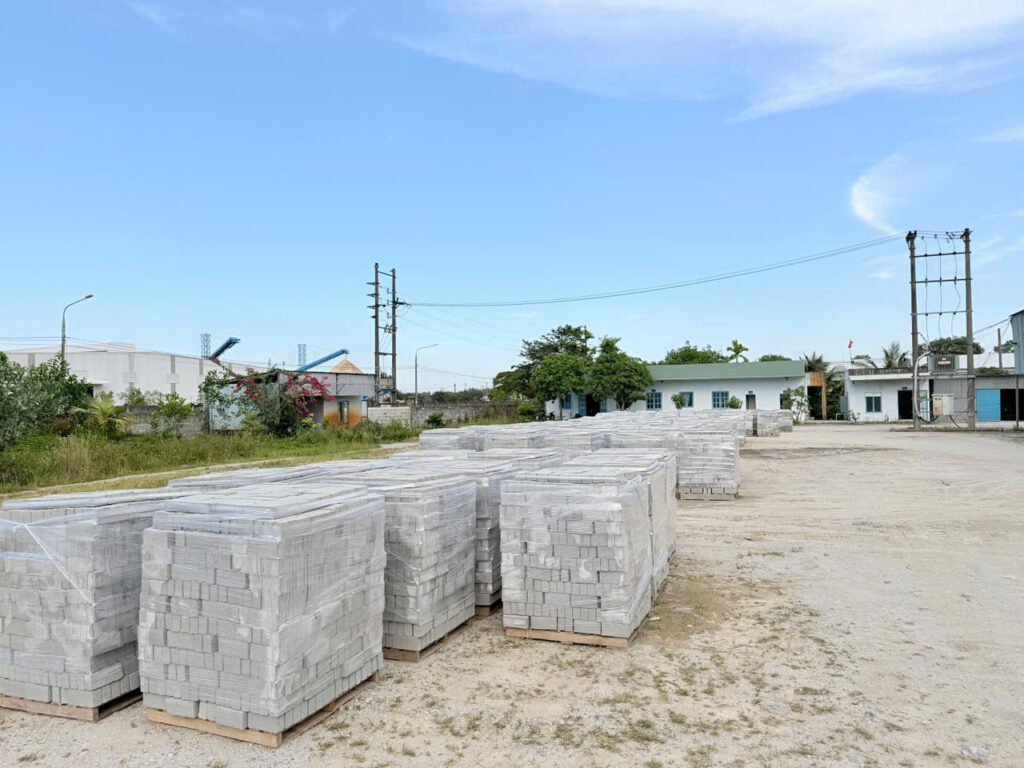
Distance from Manufacturing Facility to Project Site
Non-fired bricks are heavy masonry products, so transportation cost is particularly sensitive to the distance between the manufacturing facility and the project site.
Order Volume
Larger shipments generally allow better truck utilization and more efficient delivery planning, though this does not guarantee a fixed discount — the actual benefit depends on the supplier’s logistics arrangement.
Delivery Frequency
A single planned delivery differs from multiple smaller deliveries in terms of cost and convenience. The better approach depends on the project’s storage capacity and construction schedule, not on a fixed rule.
Site Accessibility
Narrow roads, urban sites, industrial zones, restricted delivery time windows, and unloading conditions can all affect how easily material can be delivered, which in turn affects transportation planning and cost.
How to Compare Two Supplier Quotations
When evaluating multiple offers, it helps to compare them using the same set of criteria:
| Cost / Procurement Factor | Supplier A | Supplier B |
|---|---|---|
| Product type | ||
| Dimensions | ||
| Unit price | ||
| Required quantity | ||
| Transportation | ||
| Delivery schedule | ||
| Quality documentation | ||
| Applicable standard | ||
| Estimated total cost |
Buyers should compare equivalent specifications and delivery conditions rather than automatically selecting the lowest quoted price. There is no universally “best” supplier — the right choice depends on how well each quotation matches the project’s actual requirements.
What International Buyers Should Confirm Before Purchasing Non-Fired Bricks From Vietnam
Product Specification
Confirm dimensions, material composition, strength, water absorption where relevant, and applicable standards before finalizing an order.
Quality Documentation
Request relevant technical documents, test reports, product specifications, and certification documents where applicable. Certification claims should always be confirmed directly with the individual supplier rather than assumed.
Packaging and Loading
Confirm how the product is palletized, the loading method used, protection measures during transport, and compatibility with the intended container or truck.
Delivery Terms
Confirm the delivery location, lead time, shipping method, and which party is responsible for transportation arrangements.
Quotation Validity
Ask when the quotation was issued, how long it remains valid, and what assumptions — such as quantity or delivery location — are built into the quoted price.
A Practical Non-Fired Brick Cost Checklist
☐ Product type confirmed ☐ Dimensions confirmed ☐ Technical requirements confirmed ☐ Required quantity calculated ☐ Waste allowance considered ☐ Unit price confirmed ☐ Transportation cost confirmed ☐ Delivery schedule confirmed ☐ Quality documentation requested ☐ Quotation validity checked ☐ Total delivered cost calculated
Working through this checklist helps buyers compare quotations using a consistent framework, rather than relying on unit price alone.
Common Mistakes When Estimating Non-Fired Brick Costs
Comparing different specifications
Different dimensions or performance requirements make direct price-per-piece comparison misleading, since the products are not delivering the same value per unit.
Looking only at unit price
Unit cost and delivered project cost are not the same figure. Relying on unit price alone overlooks transportation, waste, and other cost components that affect the total budget.
Ignoring transportation
This is particularly costly for heavy masonry products, where transportation can represent a meaningful share of total delivered cost.
Underestimating required quantity
Ordering less than what the project actually needs often creates additional delivery trips and procurement costs later, which are usually higher than if the correct quantity had been ordered upfront.
Using outdated quotations
Material prices and logistics conditions can change between the time a quotation is issued and when the order is placed, so older quotations should be reconfirmed before use.
Conclusion
Estimating the cost of non-fired bricks should begin with project requirements rather than a single price-per-piece figure. A reliable estimate follows a clear sequence: specification, quantity, unit price, logistics, waste allowance, and total delivered cost.
For construction projects in Vietnam, buyers can improve cost visibility by confirming product specifications, requesting current quotations, and evaluating transportation and delivery conditions alongside the material price.

TDG
Bài viết liên quan

Choosing Terrazzo Tiles for Construction Projects: What to Check Before You Commit
When it comes to paving a pavement, a courtyard, or a walkway, most buyers start with the same question: how much does it cost per square meter? That question is reasonable, but it’s often asked [...]
Xem thêm
How to Evaluate Non Fired Concrete Blocks for Modern Construction Projects 2026
Not every product labeled “concrete blocks” performs the same way on site. Two units can share the same name and general appearance while differing significantly in dimensions, compressive strength, water absorption, and long-term durability. For [...]
Xem thêmBlock "slogan-chi-tiet-tin-tuc-vi" not found